The history of Innisfail is about more than a stone house on a hill, it is a story of people and their lives entwined with the land, gardens, and numerous buildings which have risen and fallen over the 300+ years of its recorded history. Willoughby Ions who grew up there in the late 1800's may have said it best:
There is a gracious charm about old places;
The gnarled bent apple trees, the shrubs, the
flowers.
Moss covered stones, the different kinds of grasses,
Quaint flowers of another day than ours.
There is a benediction in old places,
Together with a patient tolerance;
A sort of pity for the for our hurly burly,
They are well bred, accepting circumstance.
There is a poignant beauty in old places;
And yet – the new made garden on the slope,
Eager as an expectant mother waiting
Her heritage of life, contains a hope
Which they who planted the seeds in those old places
Felt, and knew faith and patience made things
grow.
Their gardens were as young as mine, and eager
In garden golden springtimes long and long ago.
-- Poems by Willoughby Ions
Yes, there is a poignant beauty in old places, but that beauty differs from the beauty of a garden, that lasts a season or two. This bit of land in Northern Virginia was deeply entwined in the history of the state and nation of which it is a part. We intend to tell both the story of the families who called Innisfail home and provide some insight into the events that shaped those stories.
As much as we can, we will tell the stories of all those people. For 150 years the stories of some of the people that lived at Innisfail were never documented beyond being listed as property on a tax form or in a will. In those case we may only be able to list a first name and perhaps not even that. But we cannot ignore their stories because many of the buildings which have risen and fallen over the centuries were built by or for enslaved people. Also, many resident's stories did not start or end at Innisfail. Where possible and relevant we will share their expanded stories.
Finally, some stories we can't tell at all due to both the lack of written records and the intentional erasure of pre-colonization history. The land was probably used in some way by people for thousands of years. If any of the Doeg spent time here, we will probably never find any evidence of it. That being said prior to the invention of mercantile agriculture it seems unlikely that anyone would have chosen to spend more than a few days here. There is no good clay for making pots or stone for making tools. The shorelines of the nearby rivers in the surrounding area would have been better suited for permanent dwellings. However, given its location between the Occoquan and Potomac rivers and vicinity to the paths which would become Ox and Colchester roads it probably would have seen some occasional occupancy.
The written records we do have start with a Northern Neck Grant. The Northern Neck Proprietary was bounded by the Rappahannock and Potomac Rivers and had a different system that the rest of Virginia for acquiring title to land because much of it had been granted to the Culpepper family in September 1649 by King Charles II of England.
The land that would one day be called Innisfail was granted to David Waugh (son of the infamous Parson John Waugh) by the Northern Neck Proprietor, Margaret Lady Culpepper, on 24 September 1710 (NN 3:270). This original grant consisted of 600 acres located north of Pope's Head Creek and east of Piney Branch. Although in the ensuing centuries both streams have meandered a little here and there, that description still fits the 10 acres that remain. The story of those 600, or as it will turn out more acres, is what we will explore on this site.
Warning: A significant amount of the information below is known to be incorrect. It is a copy of a 20 year old web page that was not well researched. A new page is being worked on and should be released winter of 2025/26.
Innisfail was a victorian poetic name for Ireland, Although at least one resident, Hannah Ions, was born in Ireland, it seems very unlikely that she named it Innisfail. We know that in the mid 19th century it was called Woodville and in the lIon's family letters it is still referred to as Woodville. Based upon conversations with the descendants of the woman who moved to Innisfail in the 1930's she likely thought the name was evocative and decided to change the name.
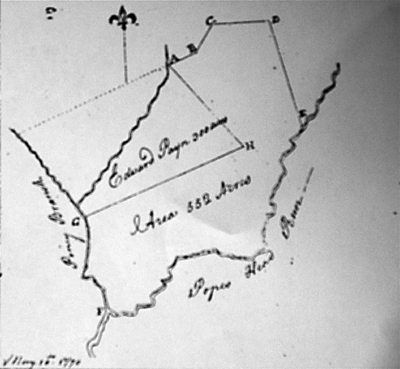
One of the earliest records of the land that would become Innisfail was the land grant to David Waugh of September 24, 1710. Sometime prior to 1733 he transferred the land to Captain Henry Conyers. Captain Conyers later split the land between his daughters giving half to his daughter Ann Holland and "the remaining 300 acres more or less" to his daughter Theodosia. As it turns out it, it was significantly more. When Theodosia's husband James DeNeale had a survey done on May 10, 1770, it was determined that there were an additional 252 acres. James had these additional acres added to the existing grant of 300 acres bring the total to 552 acres. This section is what would become Innisfail.
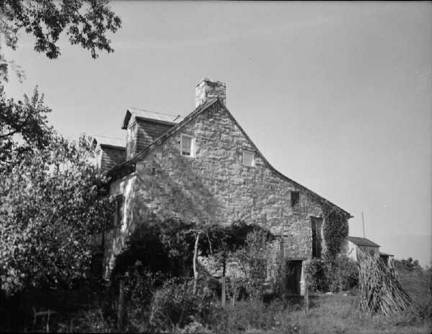
The house itself appears to have been built sometime in the late 18th Century. The most commonly cited date given for it is 1771. George DeNeale a county clerk of Fairfax/Alexandria is often said to have built it. However given that George was born in 1766, it seems highly unlikely, no matter how precocious he might have been, that he built the house when he was 5. In actuality his father James DeNeale likely built the house. Since George DeNeale became the county clerk, it appears people were confused due to the large number of legal documents that he signed in that capacity. In point of fact it looks like when his brother Hugh inherited the property, George signed it in his official capacity, greatly confusing latter generations. An excellent reference to for some if the above can be found at http://www.paynedaniel.com/TylersQtr.htm
The Register of Overwharton Parish, Stafford Co., Virginia 1723-1758 and Sundry Historical and Genealogical Notes, compiled and published by George Harrison Sanford King, Fellow, American Society of Genealogists, Fredericksburg, Virginia, dated 1961, contains these entries: From The Register of Overwharton Parish: "Married: CONYERS, Theodosia and James ODUNEAL, October 19, 1755."
Additional research found an O'DENEALE/DENEALE/DENEAL family in Stafford County, Virginia during the same time period as the O'DANIEL family. "BEGINNING AT A WHITE OAK TREE by Beth Mitchell 1977, page 278, number 54, indicates that Theodosia inherited 300 acres of land on Popeshead Creek from her father, "married James DENEAL. DENEAL, or DENEALE, found surplus of 252 acres and received a Northern Neck grant for 552 acres (NN I:210)". (This grant basically combined Theodosia's 300 acres with the surplus found by James. It was bounded by land of Edward PAYNE, Lewis ELLSEY, Thomas FORD, William KINCHELOE, and Joseph POLLARD.)
Given that a Ford did own the property to the south and east of Innisfail, and Edward Payne lived to the West, this explanation would make the most sense. Since James Deneal received his land grant, in 1772 this also fits with the house being built around 1771.
In the "Deneales of Virginia" which can be found in the Virginiana collection of the Fairfax county library, it states that James in his will gave the property to his son Hugh:
I give to my Hugh DeNeale Two negroes, Charles and John, my horse and my saddle, seven hundred dollars in cash, also three hundred acres of land to be laid off from the Lakes of the Popes head and Piny branches on the south side of Popes Head run.
This appears to be the grant that the original 300 acres and it is unclear what happened to the other 252 acres from the grant of 1772. It is strange though that he says the south of Popes Head Run, since the 552 acres are north of it.
Elizabeth was the daughter of William Scott DeNeale (d. Sept. 6, 1814 at Popeshead creek, Fairfax Co. Va. and Sybil West (b. Oct. 21, 1762 Prince George Co. Md., d. May 17, 1812 at Popeshead creek, Fairfax Co. Va. Popeshead creek Va. is where William and Sybil owned property and lived and where Elizabeth was born.
Since the DeNeale's regularly name their kids after themselves or their relatives, it is very difficult to tell when ownerships changed hands, or which member of the family is being discussed. This is particularly confusing when it comes the name James. William son of James had a brother named James and he also named one of his sons James.
On 21 December 1874 (Liber R 4:380) Robert Clarendon Ions (Jones) purchased the property. According to a survey by S. Makeley, done on 24 November 1874, the property then had 164 acres and 18 poles. On 21 January 1888 (Liber G 5:421) Robert Ions gave to his wife, Hannah, 20 acres, livestock, wagons, buggies, household furniture, cutlery, etc. for her own. The 20 acres consisted of the Log House or Cottage, made from the timber of the estate and was 48 feet by 20 feet.
Robert and his wife Hannah Nevins Ions both have tombstones several hundred yards from the house, near a foundation for another house/barn that is believed to have burned down sometime in early 1900's.
In interviews of residents done for the Historic American Buildings Survey from the 1960's their son Robert N Ions was purported to be one of the countries first licensed mail pilots. He certainly had an interest in flying.
Robert N. Ions stated in depositions in regard to the Christmas aileron patent (No. 1,095,548) that prior to 1 March 1908 on Ion's farm near Fairfax Station, Virginia, they had constructed a plane which Christmas flew in the presence of Ions and other witnesses.
More details about that can be found in the book: A Christmas Flight: Aviation Pioneer, Dr. William Christmasby Mary Buckingham Lipsey
Robert N. Ions continued to live in the house in the early 1900s and was an active member of the Democratic Executive Committee. He wrote several letters to the editor of the Fairfax Herald and contributed to the effort to repeal Prohibition. Some people say that he supplied the local area with moonshine and a large cache of bottles can still be found in a giant trash heap near the barn.
A third Ions generation also lived in the house. Estelle deWilloughby (Willoughby) Ions (the e in Iones seems to have disappeared) was born in 1881. In "Fairfax Station: All Aboard!" Willoughby is described as a free spirit who made her mark on American culture as a pianist, painter, designer, composer, and writer. She also achieved fame as the designer of the "hostess gown" after she moved to New York City. It appears Willoughby became somewhat estranged from the family. It is believed that this may have been because she was also the "companion" of Adele Clark for a time and worked in the Women's movement. Willoughby has works in the National Gallery of Art from the work she did for the Index of American Design. Richard Doud conducted an interview with Willoughby Ions for the Archives of American Art New Deal and the Arts Project on Mar. 11, 1964, which can be found at the Smithsonian.
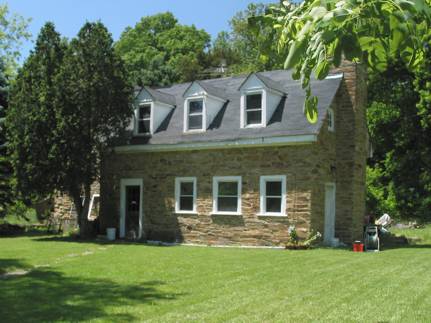
Paul W. Gordon and Harriet R. Gordon bought the house in 1935 and removed a partition on the first floor to make one large living room out of what had been two rooms. Over the next several years somewhat interrupted by World War II they renovated the house. In 1941 they added an addition on to the existing structure to replace the small lean-to like one that had can be seen in the picture above from 1936. At the same time the Gordon's added hot water radiators and limited electricity to the existing structure. The original section of the house does not have any running water.
In the late 1960's a developer purchased the house with 130 acres. In 1973 the Korper's purchased the house with 10 acres. The remainder of the land was turned into a development called Oakbrook. In order to accommodate a new road, the driveway was moved 50 feet west. The road into the development is called Innisvale Drive. Reportedly the developer was superstitious and did not want the word fail to be in the name of the road and therefore changed the name.
Other than the house and a 20th century barn none of the other buildings on the property remain. In the early 1980's a 2 room cabin was struck by lightning, caught fire and was completely destroyed along with an outhouse that was next to it. Around 1994 a log cabin about 50 feet from the house collapsed and was also completely destroyed. All that remains of the log cabin is the foundation. Several old farm implements can also be found around the property.
A great deal of additional information on the property and its history can be found in the Innisfail file in the Virginiana collection of the Fairfax County library.
A good photo of the house will have to wait until springtime, but for now the following photo (showing primarily the newer section) will have to do: